
When One Session is Enough: Music Therapy Approaches with Short- and Long-Term Hospice Clients, Pt. 1

Grace Ramsey
MT-BC
Music therapists have the privilege of working with patients throughout the human lifespan.
Whether we are supporting premature infants in a NICU unit, or supporting a patient as they transition out of this life, our field’s diversity and unique applications are what make us passionate and creative providers.
For this blog post, I chose a conversation about hospice because in this particular field, it is life and death that you are focusing on and you don’t know how long you have with that client. As music therapists we get the honor to walk through their life with them or prepare them for leaving this world behind them. We’ll take a brief look at the definition of “short-term” hospice, before diving into a case study of a recent hospice patient of mine. We’ll end with a look at a few helpful resources that you can immediately begin utilizing in your own practice.
When working hospice patients there are many elements of practice to consider; one such consideration is the difference between visits with long-term hospice patients vs. short-term patients.
A common question a clinician may encounter is,
“Wouldn't all hospice patients be short-term?”
Not necessarily. During my internship I worked with patients who had been in hospice for years with no major changes in their health. On the flip side, I had patients who were put on hospice, only to take a turn for the worse and pass away the next week. I noticed that depending on what kind of visit I would show up for, there were different needs to keep in mind.
In August 2026, in the late afternoon, I got a call about a 75 year-old woman with cancer. I was told she slept most of the day and was not able to talk or participate in conversation or activities. When I arrived for our first visit that next Monday, she was lying in bed, resting. I talked for a while with the daughter and sister and learned more about her and her musical tastes. They told me they were “praying for a miracle.”
When I entered the room, there were brothers and sisters and daughters surrounding her. I started the session by greeting her and telling her I was there to play some music. I gave her the reassurance that she could just lie there and rest and didn’t have to do anything while I was present. She did not stir. I began playing some of her preferred worship songs, including, “Rescue” by Lauren Daigle, “Waymaker” by Michael W. Smith, and “Worthy” by Elevation Worship.
From time to time she would open her eyes or move her head or her hands,
but the majority of the session she remained still and quiet, with the soft sounds of her breathing.
I shifted my focus to noticing these small movements and responses to the music. I changed my rhythm and dynamics in order to match her breathing and provide regulation in accordance with her body movements. If she appeared to rest easier- as observed by slower breathing, gentle body movement, eye contact, or appearing to smile- during a specific verse, I would repeat that verse and prolong the song. If she appeared to grimace or clinch her muscles or vocally call-out, I would end the song softly.
Near the end of the session, I played a Michael W. Smith song, called, “Above All.” A family member began to sing along; the air in the room shifted. My client’s movements stilled and her breathing relaxed. She opened her eyes for a few seconds and afterwards a family member told me that that was her trying to engage with the music. I extended the song as long as I could. It was no longer just about being there for my client, but to bring peace and support to the family as well. This is a vital part of working in hospice.
Honoring a person’s life also means you honor the lives around them.
Family members are walking through the grief and fear of not knowing if there is hope ahead. In this moment, the music brought sisters and brothers and mothers and grandmothers together. It was beautiful.
The next week, my client passed away. There were many things I would have changed about that session and there was music I wanted to learn to further capture the music she preferred, but I never got a chance. I was there for that short time. You won’t always get that chance and that’s why clinical goals will look very different. When a client is unresponsive and you don’t know how long they have, your main focus should be to bring peace and comfort to your client and their family and provide opportunities to connect with each other through music.
Interventions for short term care
Intuning with breathing
Matching rhythm
Active music making
Goals/objectives for short term care
Support for family members
Participatory grief
Relaxation
Reminiscence
Here is an example of how I match my instrument with my client's breath. I prefer guitar as it was always easier for me to work with. I start with breathing with them and count in my head to find out if it’s 4/4 time or ¾ time.
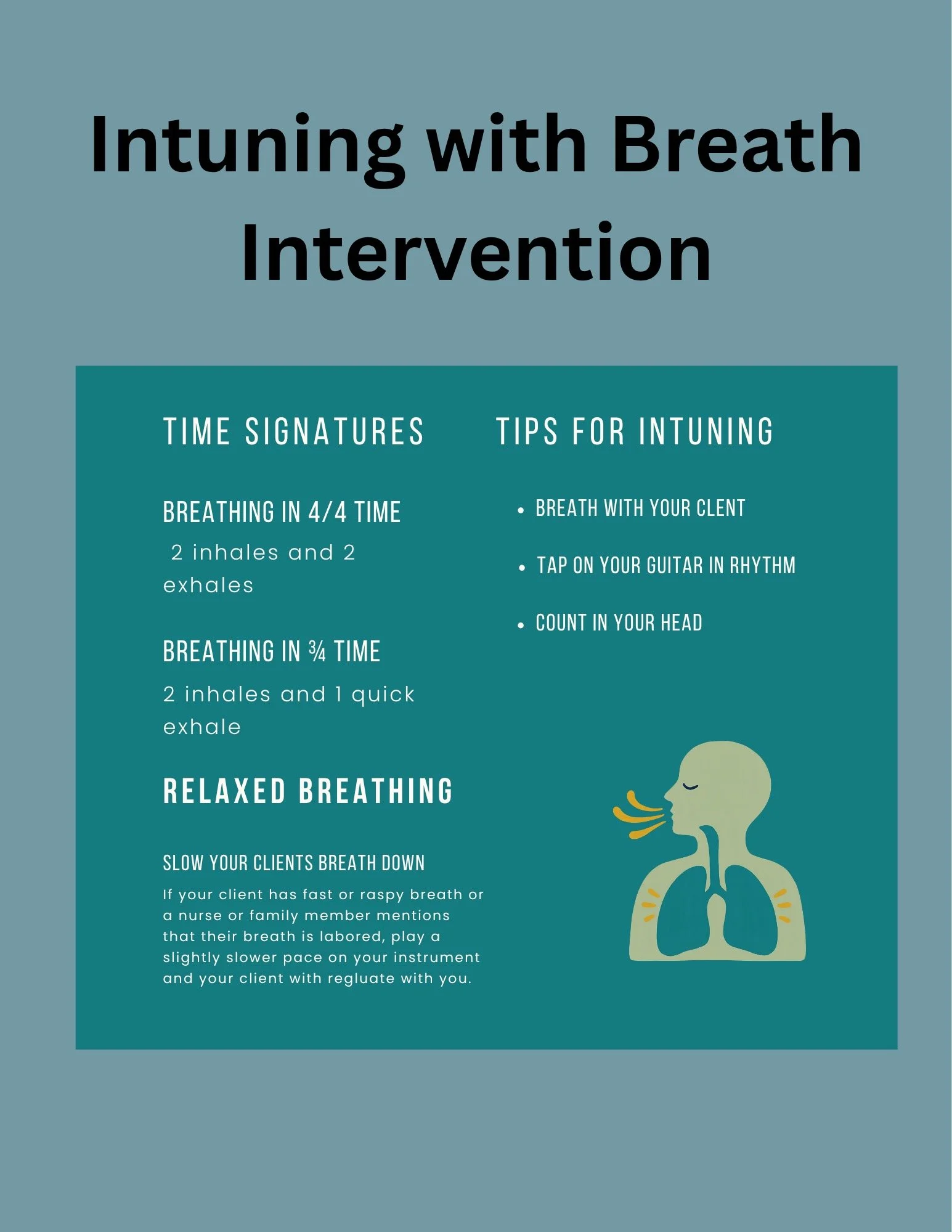
For 4/4, it would be 2 inhales and 2 exhales. For ¾. it would be 2 inhales and 1 quick exhale. You can softly tap on your guitar to help match the rhythm.
At this point I would begin playing by softly strumming on my guitar. If your client is breathing anxiously with a fast pace, you can start playing at a slower tempo than their breath, to encourage their body to regulate with your instrument and slow their breathing.
If you would like to learn more about breathwork, intuning with music, and how people regulate their breath with their surroundings, feel free to check out the articles below.
Stay tuned for part 2 where we’ll discuss experience with long-term hospice clients.
https://finnupham.com/2016/10/17/breathing-in-music-making-time-in-music-2016/