
The “One Thing” That Changed Everything: A Music Therapy Case Study

Grace Ramsey
MT-BC
I have a client, let’s call him Damian.
He is in high school and seeking services for anger management. The first day I met with him, he was quiet and reserved. He would answer direct questions with short one word answers. When I asked him about his musical preferences, he said he had tried drums and guitar, but nothing had stuck. After talking with his mom and giving her my first meeting spiel, I left making a plan to build rapport and explore Damian’s interests.
The following week I opened up the session with my usual “go to”, an emotion check-in using the app, How We Feel. This app gives you plenty of emotion words to choose from that are color coded, just like on a feelings wheel. You can click on each word to get a description of its meaning and then choose to “check in”, where it saves your emotions so you can go back and recall how you were feeling on any given day. This also helps me as the therapist to take notes during the visit for my note later.

Then I gave him my iPad to start an ice-breaker activity where we took turns writing a beat on the app, GarageBand. This is one of my favorite apps to use with Apple products. It has a variety of sounds and settings that can be used to create whole songs or just loop a beat. It’s a great way to assess a client's interests, skill level and comfort level with you and music in general.
I offered him my selection of instruments. He mentioned that he once learned a song on the guitar and agreed to show it to me. After playing a short picking pattern, he said he was done and didn’t want to play anymore. I offered him an intervention where we play the drums to a preferred song, but he declined to participate. I asked him if he was interested in songwriting and he said that he had written some things but again, declined to try it. It felt that at every turn, he was not interested in what music therapy had to offer. I could feel myself beginning to get discouraged. What could I offer him (and would it work), or…
was it just that music therapy was not a good fit for him?
Questions were swirling in my brain.
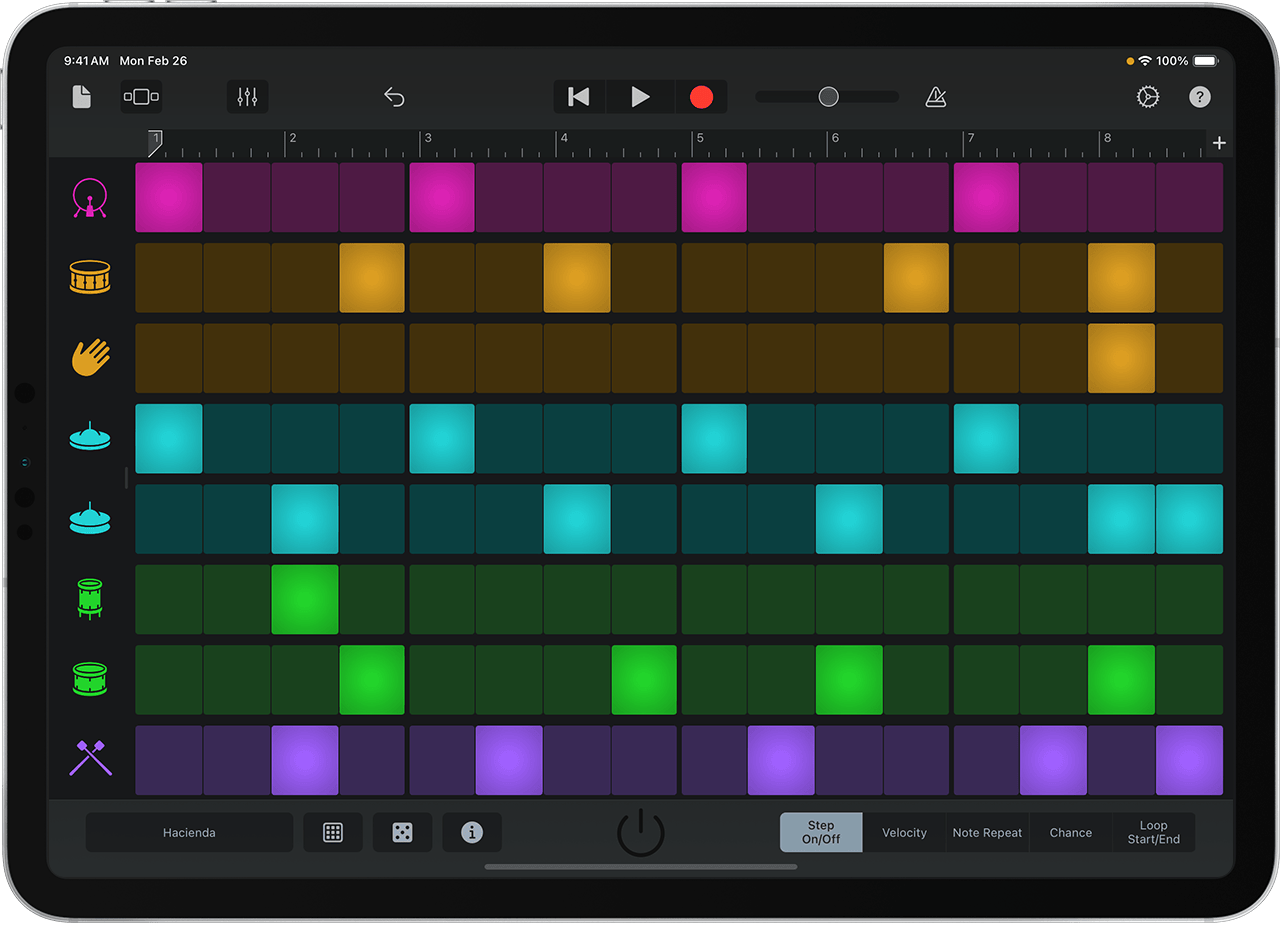
For the next month we focused on engaging with GarageBand, building a playlist, practicing lyric analysis, and using a variety of apps to write songs.
However, these interventions would only take up to 30 minutes before he was done participating. When asked if he wanted to continue, Damien would say he was “good” and there was nothing else he wanted to do.
I was constantly scratching my brain, wondering,
“What else can I do or bring to the table?”
His goals at this time were “emotional expression” and “building confidence”. But his lack of overall sustained participation made me feel at a loss.
I checked in with Damien at the end of the session that day and asked how he felt music therapy was going, and if he wanted to continue. He said he didn’t think it was making a big difference. So, we made a deal: I told him that we would try for two more weeks.. If, at the end of those two weeks , he still felt the same way, then we could end services. He agreed.
After the session, I researched and talked with my fellow music therapists for inspiration. I was determined to not give up on the process. I could see the potential with the right interventions; Damien showed an interest in music and instruments (especially guitar playing and songwriting), and maybe just needed the right combination of support, time, and space to feel comfortable and safe. I came up with some new ideas and presented them to him the following week. We slipped into the following routine:
Start with emotion check-in
He chooses an intervention out of the following:
Garageband
Listening to preferred music while writing a journal prompt
Lyric analysis
Re-writing lyrics of a preferred song
End with emotion check-in
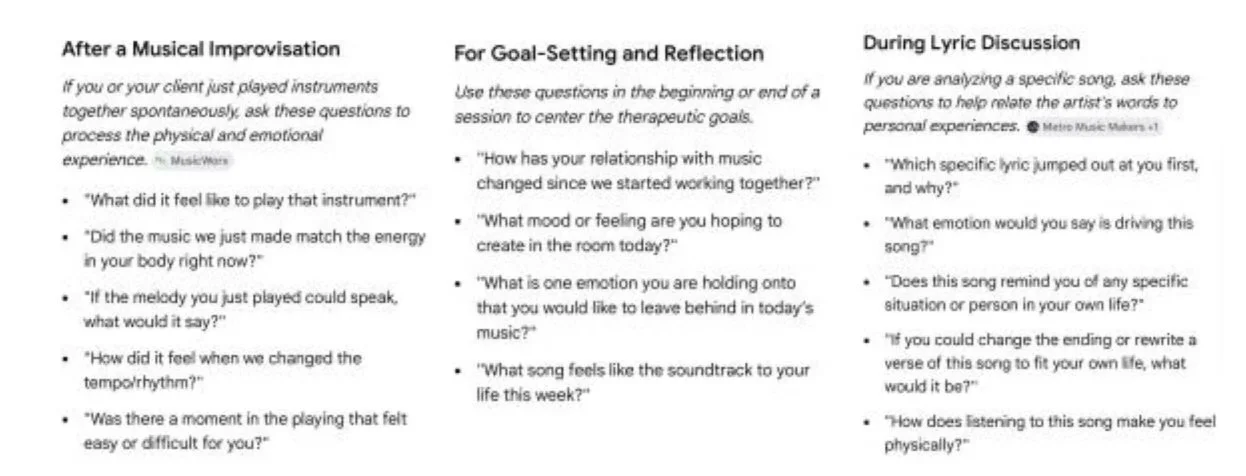
I found a list of questions that helped guide the lyric analysis, songwriting and check-ins which provided stability and consistency. Damien continued to give short answers but grew used to the routine that I set. When I checked in a couple weeks later, Damien said that he liked what we were doing and wanted to continue with Music Therapy. My heart soared.
I didn’t give up on the process, and neither did he, and it was paying off.
As time went on I continued to adapt the session to his needs and bring new things to the table. A few things I noticed over time:
Damien liked doing things on his own
He preferred minimal conversation and independent work
He enjoyed the personal reflection time supported by music, sharing that it was helpful for him to get things out of his head and onto paper.
Over time, I noticed that I could ask more and he would share more. He began to open up, slowly and surely and engage more in the process. I went at his pace, didn’t push him into anything he didn’t want to do, and checked-in periodically to see how he was feeling. I let him know that this was his safe space, that he didn’t have to share anything with me and could just write it down on his notepad and process it there.
This experience has been a rewarding one. It taught me a lot. It taught me to slow down, to pay attention to what my client was giving me at first, to get creative. It taught me to communicate more effectively with my client and incorporate him into the session in the ways that he wanted to be. It’s not always a straightforward path to therapy or growth or building that client-therapist relationship. But with time, professional self-reflection, and reaching out to trusted colleagues, I was able to support my client in the music therapy space. Damien challenged me to grow and be a better therapist.
If you’re interested in more info on how Music Therapy can help your loved on, click the link below!
Resources
Apple. (n.d.). GarageBand. https://www.apple.com/mac/garageband/
How We Feel Project. (n.d.). How We Feel (Version 2) [Mobile app]. Apple App Store.https://apps.apple.com/
Music Therapy & Wellness Services San Diego, CA. MusicWorx. (2025, May 6).https://musicworxinc.com/
In-home & online music lessons. Metro Music Makers. (2025, April 1). https://www.metromusicmakers.com/